To climb arena rating in WoW, pick one spec and master it. At each bracket, there's a specific set of skills that matters most: below 1600, focus on using your defensives and not dying. At 1600-1800, learn to coordinate crowd control before bursting. At 1800+, master cooldown trading and kill window recognition. Review your mistakes after every session - players who identify and fix their most frequent error climb faster than those who just grind games.
What Is WoW PvP?
World of Warcraft PvP (Player vs Player) is competitive combat between real players. Arena - the most popular ranked PvP format - pits teams of 2 or 3 players against each other in short, intense matches where positioning, cooldown management, and crowd control determine the winner.
Arena has a rated ladder system where you gain or lose rating based on wins and losses. Higher ratings unlock titles, gear upgrades, and cosmetic rewards. The two main formats are Solo Shuffle (you queue alone and get matched with random teammates for 6 rounds) and 3v3 (you bring your own team of 3).
The skill curve in arena is steep. Most players plateau somewhere between 1400 and 1800, not because they lack talent but because they don’t know which skills to focus on at their current level. This guide fixes that.
WoW Arena Rating Milestones
The 5 Skills That Decide Every Arena Match
Before diving into rating brackets, you need to understand the five core skills that determine who wins. Every piece of advice in this guide maps back to one of these.
1. Defensive Cooldown Usage
The single most impactful skill at every rating. ArenaCoach data shows that “died with defensives available” is the most common mistake below 2100. If you have Ice Block or Divine Shield or any major defensive and you die without pressing it, that’s not a damage problem - that’s a usage problem.
The rule: When you drop below 50% HP and your healer is in CC, press a defensive. Don’t wait until you’re at 10% hoping your healer will save you.
2. Crowd Control Coordination
Kills in arena don’t happen through raw damage. They happen when the enemy healer can’t heal because they’re in crowd control. CC-related mistakes are among the most frequently detected patterns in arena matches.
The rule: When you have pressure and want to try and score a kill, someone on your team needs to CC the healer without messing it up. One Hammer of Justice, one Psychic Scream, one anything. Don’t waste your kill attempts by letting healers free cast.
3. Interrupt Discipline
Your interrupt (kick) has a cooldown. If you use it on a junk cast, it won’t be available for the important one. Kicking a Frostbolt while your healer is stunned and Polymorph is coming 1 second is going to cost you games.
The rule: Save kicks for casts that will kill you or your teammate, or for CC that would put you behind or lose you the game. Let the low-value casts go through.
4. Cooldown Trading
Arena is an economy game. Every offensive cooldown, defensive cooldown, and trinket is a resource. The team that gets better value from their cooldowns wins. Using long CD offensives into targets that just pressed shorter cooldown defensives is a bad trade.
The rule: Always be aware of active enemy defensives. Burst when they’re down, not when they’re up. If you force a defensive, that’s a win - wait it out and go again.
5. Positioning and Line of Sight
Every arena map has pillars. Pillars block both damage and healing. If you’re standing in the open, you’re taking maximum damage. If you’re behind a pillar when the enemy team goes on you, you can break line of sight and buy your healer time.
The rule: When you’re in trouble, use pillars. If you’re being focused, move toward a pillar, not away from it.
- These 5 skills matter at every rating. What changes is how precisely you need to execute them.
- Below 1800, mastering just #1 (defensives) and #2 (CC) will carry you further than anything else.
- Skills #4 and #5 (cooldown trading, positioning) separate 1800 players from 2100+ players.
- You don't need to be good at all 5 simultaneously. Focus on the one you're worst at.
How to Climb Rating: Bracket by Bracket
Every rating bracket has a specific set of mistakes that dominate. Fix the mistakes for your bracket and you climb. It’s that simple - and that hard.
1400–1600: Stop Dying
This is where most players start and where many get stuck. The good news: games at this rating are decided by basic errors, not skill gaps.
What’s happening at this bracket:
- Players die with major defensives still available in 40%+ of losses
- Burst happens without any CC setup
- Interrupts are used randomly, not strategically
- Trinkets are used when there’s no pressure
Your 3 priorities:
-
Use your defensives before you die. This sounds obvious. It isn’t. Watch any replay of a 1400-rated game and count how many deaths happen with Ice Block, Barkskin, or Astral Shift still available. ArenaCoach catches this automatically - check your own games.
-
Keybind everything. If you’re clicking abilities, you’re reacting 200-500ms slower than someone using keybinds. That’s the difference between pressing a defensive in time and dying. Every ability should have a keybind.
-
Play one spec. Don’t switch. Muscle memory takes hundreds of games to build. Every time you swap specs, you reset that progress. Pick the spec you enjoy most and commit for at least a full season.
Expected climb: 1400 → 1600 typically takes 2-4 weeks of consistent play (5-8 hours/week).
1600–1800: Learn to Set Up Kills
You’re using your defensives now. You’re not dying for free. But you’re struggling to get kills, and games drag on or you lose to dampening. The issue: you’re trying to kill through raw damage without CC.
What’s happening at this bracket:
- Burst goes out while the enemy healer is free to heal
- CC chains break because of incidental damage (DoTs, cleave)
- Offensive cooldowns are used into enemy defensives
- Target swaps happen too late or not at all
Your 3 priorities:
-
CC before burst. This is the single biggest skill jump between 1600 and 1800. Before you use offensive cooldowns, someone needs to CC the healer. Polymorph → Combustion is a kill. Combustion alone is a heal check that you’ll usually lose.
-
Learn diminishing returns. CC of the same DR category gets shorter each time: full → 50% → immune. If your partner just used a Fear, don’t immediately follow with Blind - use a CC from a different DR category, or wait 18 seconds for DR to reset.
-
React to enemy offensives. You can’t track everything yet. Pick the most dangerous enemy cooldown and pay attention to when it’s used. Don’t get caught taking a ton of damage without realising the Warrior has Avatar up.

Expected climb: 1600 → 1800 typically takes 3-6 weeks. This is the steepest skill wall for most players.
1800–2100: Master Cooldown Trading
You coordinate CC. You use defensives. Games feel closer now - wins and losses come down to small edges. At this bracket, the economy of cooldowns is what separates you from Duelist.
What’s happening at this bracket:
- Defensive cooldowns get stacked (two defensives used when one was enough)
- Kill windows are missed because players don’t recognize when the enemy has nothing left
- Offensive pressure goes into enemy walls and gets wasted
- Players don’t adapt to the enemy comp’s win condition
Your 3 priorities:
-
One defensive at a time. If Barkskin is enough to survive the go, don’t also press Ironbark. Stacking two defensives into one enemy go means you have nothing for the next one.
-
Recognize kill windows. The enemy DPS used their trinket 30 seconds ago. Their Disc Priest has no trinket and just used Pain Suppression. Your burst is ready. Go now. Use defensives offensively if you need to. The window won’t last. Learning to see these moments - and committing immediately - is the difference between 1800 and 2100.
-
Understand your comp’s win condition. Every composition has a game plan. Are you a burst comp that wins in the first 2 minutes? An attrition comp that wins through sustained pressure and dampening? A control comp that needs healer CC chains to kill? Do you know your best kill targets? If you don’t - check your spec’s class guide on ArenaCoach.

Expected climb: 1800 → 2100 typically takes 1-3 months. The rate slows because mistakes are less frequent and harder to identify without tools.
2100–2300: Find the Edges
You’re in the top few percent now. Mistakes are rarer and subtle. Climbing here is about preparation, matchup knowledge, and consistency over long sessions.
Your 3 priorities:
-
Matchup preparation. Before the gates open, know your game plan against the enemy comp. Who’s the kill target? What’s their dangerous window? What cooldowns do you need to save? Check ArenaCoach’s matchup data for win rates and patterns.
-
Positional discipline. At this rating, being 2 yards out of position gets punished. Pillar play, line of sight manipulation, and forcing the enemy team to overextend are where games are won.
-
Session management. Tilt is real. If you lose 3 in a row and feel frustrated, stop. Take a break or end the session. The next game you play while tilted is worth -50 rating, not +15.
Expected climb: 2100 → 2300 typically takes a full season for most players. This is where consistent daily play matters more than long binge sessions.
2300+: The Gladiator/Legend Push
At this level, you’re facing the same players repeatedly. You know their names, their comps. Climbing requires a different kind of improvement.
Your 3 priorities:
-
Study your opponents. Look up their character pages on ArenaCoach. Check their match history and their stats.
-
Team synergy over individual skill. At Gladiator/Legend level, those that play for their team usually win. In Shuffle, don’t ignore what your teammates are doing. In 3v3, find partners you’re compatible with and invest in the team - shared strategies, practiced openers, post-session reviews together.
-
Watch high-rated play. AWC footage and R1 streamers expose strategies you won’t encounter in your own games until you’re already at that level.
Solo Shuffle vs. 3v3: Which Is Better for Climbing?
This is one of the most common questions in WoW PvP, and the answer depends on where you are.
| Decision lane | Preferred default | What to avoid |
|---|---|---|
| Queue time | Solo Shuffle: Queue solo, no team-finding needed | 3v3: Finding a team through LFG can take longer than playing |
| Games per hour | Solo Shuffle: 6 rounds per queue, high volume | 3v3: Fewer games per hour, especially with LFG downtime |
| Learning speed | Solo Shuffle: Forces you to adapt to different teammates every round | 3v3: Can develop bad habits if your team compensates for your mistakes |
| Climbing speed | 3v3: Coordinated teams climb faster with consistent play | Solo Shuffle: Going 3-3 is common and feels like treading water |
| Consistency | 3v3: Same team means same strategy, less variance | Solo Shuffle: Random teammates create high variance in results |
| Skill transfer | Solo Shuffle: Teaches you to play independently and read unfamiliar situations | 3v3: Skills can become comp-dependent and partner-dependent |
The recommendation:
- Below 1800: Play solo shuffle. You’ll get far more games, learn faster, and don’t need to wait for teammates. The skills you build - defensive usage, CC timing, individual decision-making - transfer to every format.
- 1800–2100: Start playing both. Use solo shuffle for volume practice and 3v3 for climbing when you have a good team online.
- 2100+: Focus on 3v3 if you want Gladiator. The highest ratings and the Gladiator title require 3v3 wins. Solo shuffle is still valuable for warming up and practicing new strategies.
Essential Addons for Arena
You can technically PvP without addons, but you’re handicapping yourself. Here are the addons that matter, in priority order.
Must-Have
- sArena Reloaded - enemy arena frames that show health, class, trinket status, and DR timers. Without this, you’re guessing.
- MiniCC - shows CC, defensive, and important spell notifications to help increase your awareness of what’s happening in the match.
- BetterBlizzPlates - enhances the default Blizzard nameplates with more features and easy settings. Makes enemy nameplates cleaner in arena.
- ArenaCoach Addon - auto-generates your combat log so ArenaCoach can analyze your mistakes after each session. Zero configuration needed.
Strongly Recommended
- FrameSort - sorts party and arena frames so you can stack party 1 and party 2 consistently, which is essential for party 1/2 macros.
- BetterBlizzFrames - a quality of life all-in-one improvement addon for the default Blizzard unit frames. More features without replacing the stock UI.
- HealthBarColor - changes unit frame health bars to class colors, making it easier to identify targets at a glance.
- MiniOverShields - displays absorb shields on health bars so you can see how much effective HP a target actually has.
- Details! - a better looking damage and healing meter than the default Blizzard one.
Macros and Keybinds for Arena
If you’re clicking abilities or manually targeting enemies, you’re losing fights before they start. Macros are non-negotiable. You need two main types - focus macros and party macros - and you can optionally add arena target macros on top.
Focus macros
Your focus target is the enemy you want to track without actually targeting them - usually the healer. Set focus on them when the match starts, then use focus macros to CC them without switching off your kill target.
The setup: put your CC on a keybind, then put the focus version on a modifier of the same key. If Hammer of Justice is on F, then Shift+F casts it on your focus:
/cast [@focus] Hammer of JusticeF stuns your kill target. Shift+F stuns the healer. You never change target. This works for any CC - Polymorph, Fear, Blind, whatever your class has.
You don’t need macros to set focus on arena 1, 2, 3 - those are set in WoW’s keybind settings directly. A good setup is mouse wheel up for focus arena 1, mouse wheel down for focus arena 2, and middle click for focus arena 3. That way you can swap who your focus macros target on the fly without taking your hands off anything.
Party 1/2 macros
If you play a healer, Ret Paladin, or anything with external cooldowns, party macros let you cast on teammates without targeting them. Party 1 and 2 match your party frames top to bottom.

#showtooltip Blessing of Protection
/cast [@party1] Blessing of Protection
#showtooltip Blessing of Protection
/cast [@party2] Blessing of ProtectionIf your teammate is about to die, you can save them with Blessing of Protection instantly. Without a party macro, you have to click their frame to target them first and then press the keybind - that extra step takes time you don’t have, and it might cost them their life.
The FrameSort addon from the addons section matters here - it keeps party 1 and party 2 in a consistent order so your muscle memory for “party 1 is always the top frame” works every game.
Arena 1/2/3 macros (optional)
Arena macros cast abilities directly on specific enemies without changing your target. Arena 1, 2, 3 match the enemy frames top to bottom. These are especially good for ranged interrupts and spammable ranged CC like Polymorph and Fear where you want to hit a specific target across the arena without swapping to them:
#showtooltip Polymorph
/cast [@arena1] Polymorph
#showtooltip Polymorph
/cast [@arena2] Polymorph#showtooltip Polymorph
/cast [@arena3] PolymorphNot everyone uses arena 1/2/3 macros - they’re an extra layer on top of focus macros. But if you play a caster, they let you CC or kick any enemy instantly regardless of who you’re targeting or have on focus.
The Mistakes That Hold You Back
We analyzed over 40,000 arena matches to identify the most common mistakes across all brackets. Here’s what the data shows:


For the complete breakdown with frequency data and fix strategies for each mistake, read the Top 10 Arena Mistakes Holding You Back. For automatic detection of these patterns in your own games, download ArenaCoach.
How to Review Your Games (and Why It Matters)
Grinding games without reviewing them is like taking a test without checking your answers. You might improve through repetition, but you’ll improve 3-5x faster if you know what to fix.
Option 1: ArenaCoach (Free, Automated)
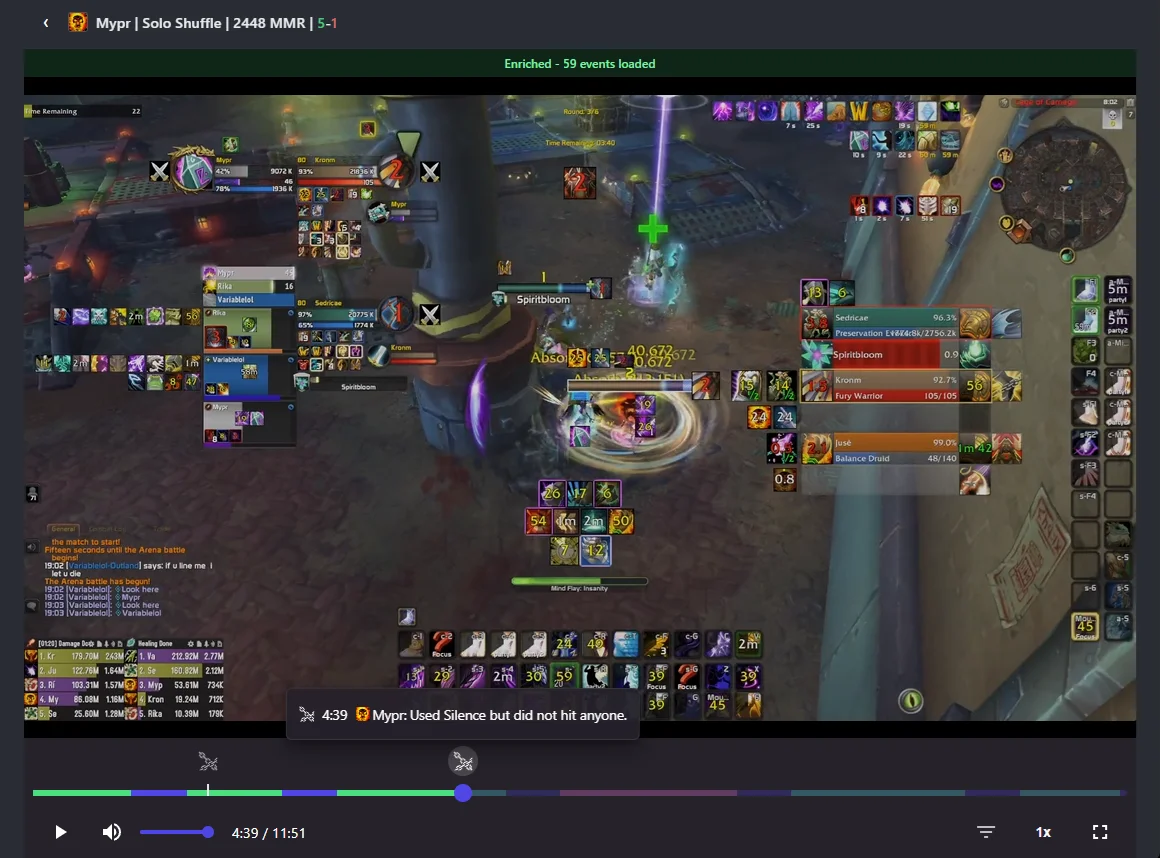
ArenaCoach records your matches automatically and runs them through a simulator engine that detects over 40 mistake patterns. After each session, you see exactly which mistakes appeared, how often, and at what timestamps. No manual VoD scrubbing required.
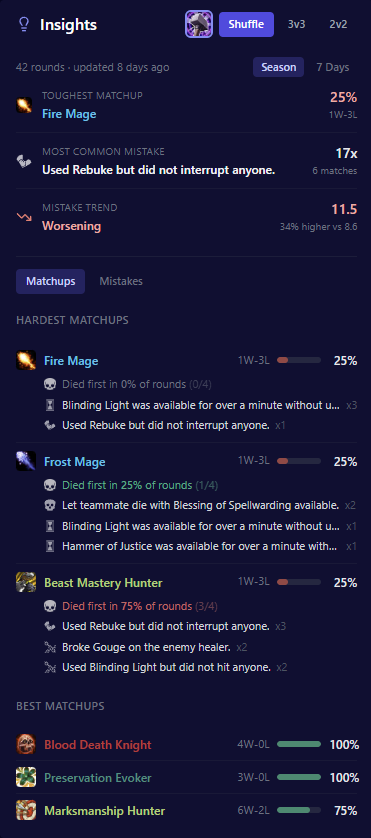
Your character page shows your match history, performance stats, and - with Premium - insights on your toughest matchups and mistake trends over time.
For a deeper look at how it works, read the Arena Coach guide.
Option 2: Manual VoD Review
If you prefer to review yourself:
- Record your games with OBS
- After your session, watch 2-3 of your losses
- For each death, ask: “Did I have a defensive I didn’t use?” and “Was there CC on the healer when we tried to kill?”
- Write down the one mistake you made most often
- Next session, focus exclusively on that one thing
The One-Mistake Method
How to Find Arena Partners
Solo shuffle doesn’t require partners, but 3v3 does - and finding reliable teammates is one of the hardest parts of arena.
Where to Look
- WoW Group Finder (keybind: I) - the in-game LFG tool has a PvP section.
- Skill Capped Discord - team-finding channels organized by region.
- r/worldofpvp’s Discord - the Reddit PvP community.
What Makes a Good Partner
- Consistency over rating. A 1600 player who queues with you 4 days a week will help you climb faster than a 2000 player you play with once a month.
- Willingness to review. Partners who watch replays together and discuss mistakes improve as a team, not just as individuals.
- No blame. If someone blames teammates after every loss, find someone else. Improvement comes from looking at your own play, not pointing fingers.
Mental Game: Tilt, Plateaus, and Consistency
Tilt Management
Tilt is the single biggest rating destroyer that has nothing to do with gameplay skill. When you’re tilted, you make worse decisions, react slower, and play scared or reckless.
The 3-loss rule: If you lose 3 games in a row, take a 10-15 minute break. Walk away from the screen. When you come back, your decision-making resets. This single rule prevents more rating loss than any gameplay improvement.
Plateaus Are Normal
Every player plateaus at some point. The 1600 wall, the 1800 wall, the 2100 wall - these are real, and everyone hits them. A plateau means you’ve exhausted the easy improvements and need to find the next set of mistakes to fix.
When you’re stuck:
- Check your ArenaCoach mistake trends - what’s your most frequent mistake right now?
- Watch 5 losses in a row and look for the common thread
- Consider that the issue might be strategic (wrong win condition, bad target selection) rather than mechanical
- Take 2-3 days off. Sometimes your brain needs rest to consolidate what you’ve learned.
Consistency Beats Brilliance
One hour of arena per day is better than one 7-hour session per week. Your muscle memory, game sense, and mental sharpness all benefit from daily practice. If you can only play on weekends, that’s fine - but spread your hours out rather than binging.
- Pick one spec and commit for a full season. Muscle memory takes hundreds of games.
- At every bracket, there's one skill that matters most. Focus on that, not everything.
- Review your mistakes after every session. ArenaCoach automates this for free.
- Solo shuffle for learning, 3v3 for climbing. Use both.
- Tilt destroys more rating than bad gameplay. Use the 3-loss rule.
- Consistency beats brilliance. Daily short sessions outperform weekly binges.
Frequently Asked Questions
For more questions about arena mechanics, addons, and ArenaCoach, visit the full FAQ.
How does arena rating work in WoW?
Arena rating (CR) starts at 0 and goes up or down based on wins and losses. The amount gained or lost depends on your MMR (matchmaking rating), which is a hidden number that reflects your actual skill level. When your CR is below your MMR, you gain more per win and lose less per loss. When CR is above MMR, the opposite happens. Rating and MMR converge over time.
What rating is considered good in WoW PvP?
1600 puts you above average. 1800 (Rival) means you're solidly competent. 2100 (Duelist) puts you in the top few percent of arena players. 2300+ (Elite) makes you eligible for Gladiator. Most players never reach 1800, so hitting Rival is a genuine achievement.
How long does it take to get to 1800 in arena?
For a focused player starting from scratch, reaching 1800 typically takes 2-4 months of consistent play (5-8 hours per week). The time varies enormously based on prior PvP experience, class choice, and whether you review your mistakes between sessions. Players who use tools like ArenaCoach to identify patterns climb faster because they fix the right things.
What is the best class for arena in WoW?
The best class depends on the current meta and your playstyle. For climbing, what matters most is picking one spec and mastering it rather than chasing whatever is S-tier this week. That said, specs with strong defensive toolkits and crowd control tend to be more forgiving while learning. Check the ArenaCoach tier list for current rankings.
Is Solo Shuffle or 3v3 better for climbing rating?
Solo Shuffle is better for learning because you play with different teammates every round, forcing you to adapt. You also get far more games per hour. 3v3 is better for climbing once you have a consistent team, because coordinated play is rewarded more. Most players should start with Solo Shuffle and spend more time in 3v3 when they have reliable partners.
What addons do I need for WoW PvP?
The essentials are: sArena Reloaded (enemy arena frames), MiniCC (CC, defensive, and spell notifications), BetterBlizzPlates (enhanced nameplates), and the ArenaCoach addon (auto combat log for mistake analysis). For UI improvements, add FrameSort, BetterBlizzFrames, HealthBarColor, and MiniOverShields.
What macros do I need for arena?
You need focus macros and party macros at minimum. Focus macros let you CC an enemy (usually the healer) without switching off your kill target - put your CC on a key and the focus version on a modifier like Shift. Party macros let you cast externals like Blessing of Protection on teammates instantly without clicking their frame. Arena 1/2/3 macros are optional but useful for casters who want to CC or interrupt specific enemies across the arena.
What are the best keybinds for WoW arena?
Bind all abilities to keys you can reach without moving your hand off WASD. Use Shift, Ctrl, and Alt modifiers to triple your available binds. For focus target swapping, mouse wheel up/down/middle click for arena 1/2/3 focus is a popular setup. Every ability should be keybound - if you're clicking anything in arena, you're reacting too slowly.
What is diminishing returns in WoW PvP?
Diminishing returns (DR) means that repeating the same category of crowd control on a target makes it last shorter each time. First CC is full duration, second is 50%, third is immune. DRs reset after 18 seconds of not being hit by that category. Understanding DR categories and timing your CC accordingly is one of the biggest skill jumps in arena.
Why am I stuck at 1600 in arena?
The 1600 plateau is almost always caused by one of three things: dying with defensive cooldowns still available, missing your crowd control, or wasting your PvP trinket. ArenaCoach data shows these three mistakes account for the majority of losses in the 1400-1800 bracket. Fix the most frequent one first.
How do I find arena partners?
The WoW Group Finder (default keybind: I) has a PvP section where players list groups. The SkillCapped Discord and the r/worldofpvp's Discord are also good places. For solo shuffle, you don't need partners at all. When looking for 3v3 partners, prioritize consistency over rating - a 1600 player who shows up every day is worth more than a 2000 player who plays once a week.
How many hours does it take to reach Gladiator?
Most Gladiator players report 500-1000+ hours of total arena experience before achieving the title, though this varies enormously. The key factor is not raw hours but deliberate practice - players who review mistakes, study matchups, and focus on specific weaknesses improve far more per hour than those who grind without reflection.
Changelog
- Published for Midnight Season 1.